

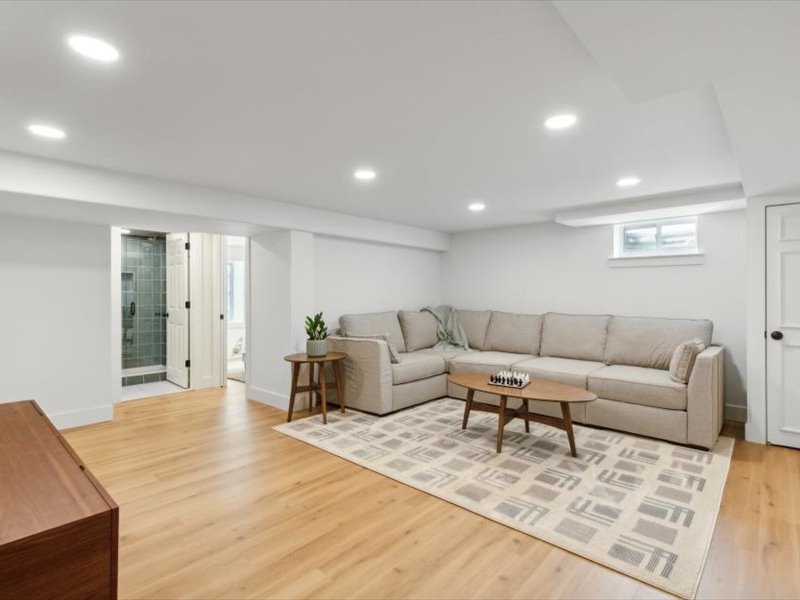
A finished basement often starts as a practical idea: more room for guests, a quieter office, a place for teenagers to spread out, or a den that can handle real daily use. Then the flooring decision gets tricky. In older homes around Wayne, lower levels can feel cool, hold a bit more ambient moisture, and see plenty of traffic from pets, kids, and backyard entries. That combination is exactly why laminate deserves a serious look.
Why laminate makes sense below the main level
Basements ask more from a floor than many first-floor rooms do. Temperatures shift, humidity can linger, and a surface that looks polished upstairs may feel too delicate downstairs. In many cases, our laminate selection gives homeowners the wood-look they want with a tougher wear layer for everyday use.
That matters most in spaces designed to work hard. A basement family room may see rolling chairs, game storage, exercise equipment, and the occasional wet sneaker. Laminate performs best here when the subfloor is flat, the room is properly conditioned, and moisture issues are addressed before installation rather than hidden under it.
The moisture question matters more than the style question
Most people start by comparing color and texture, but the smarter first step is evaluating the room itself. A basement can be finished beautifully and still have seasonal dampness that affects flooring over time. If the space has a history of moisture intrusion, or if the slab tests high, we usually steer the conversation toward luxury vinyl options, because that category is often better suited to those conditions.
If the lower level is dry and stable, laminate can be an excellent fit. The key is honest prep. We look at transitions, expansion space, subfloor condition, and how the room is heated and cooled. That planning is part of why our residential installation work tends to hold up well long after the project is done.
What to look for in a basement laminate floor
Not every laminate floor belongs below grade. We tell homeowners to focus less on trend language and more on construction details that affect daily life: surface durability, locking strength, board thickness, and how realistic the pattern looks across a larger room. In a basement, repeated visuals stand out faster than they do in a smaller bedroom.
It also helps to compare a few manufacturers side by side. Some homeowners gravitate toward the cleaner, contemporary visuals in Mannington laminate, while others prefer a more traditional grain pattern. Seeing those differences in person usually saves time, because undertones that look simple online can shift noticeably under basement lighting.
Basement floors should match how you actually live
A lower level rarely stays single-purpose for long. Today's media room becomes tomorrow's guest suite, workout area, or homework zone. That is why we think about acoustics, furniture movement, and maintenance just as much as appearance. A floor should support the way the room changes, not lock you into one use.
At Alpine Flooring & Design, we also pay attention to the bigger picture of the house. A basement floor should feel connected to the rest of the home without pretending to be the same environment. If you are comparing options for laminate flooring in Wayne, the best choice is usually the one that balances design continuity with the realities of a below-grade space.
If you're planning a basement update and want clear advice on what will perform well in your home, we’d be glad to help you sort through the options and next steps with a free flooring estimate.


