

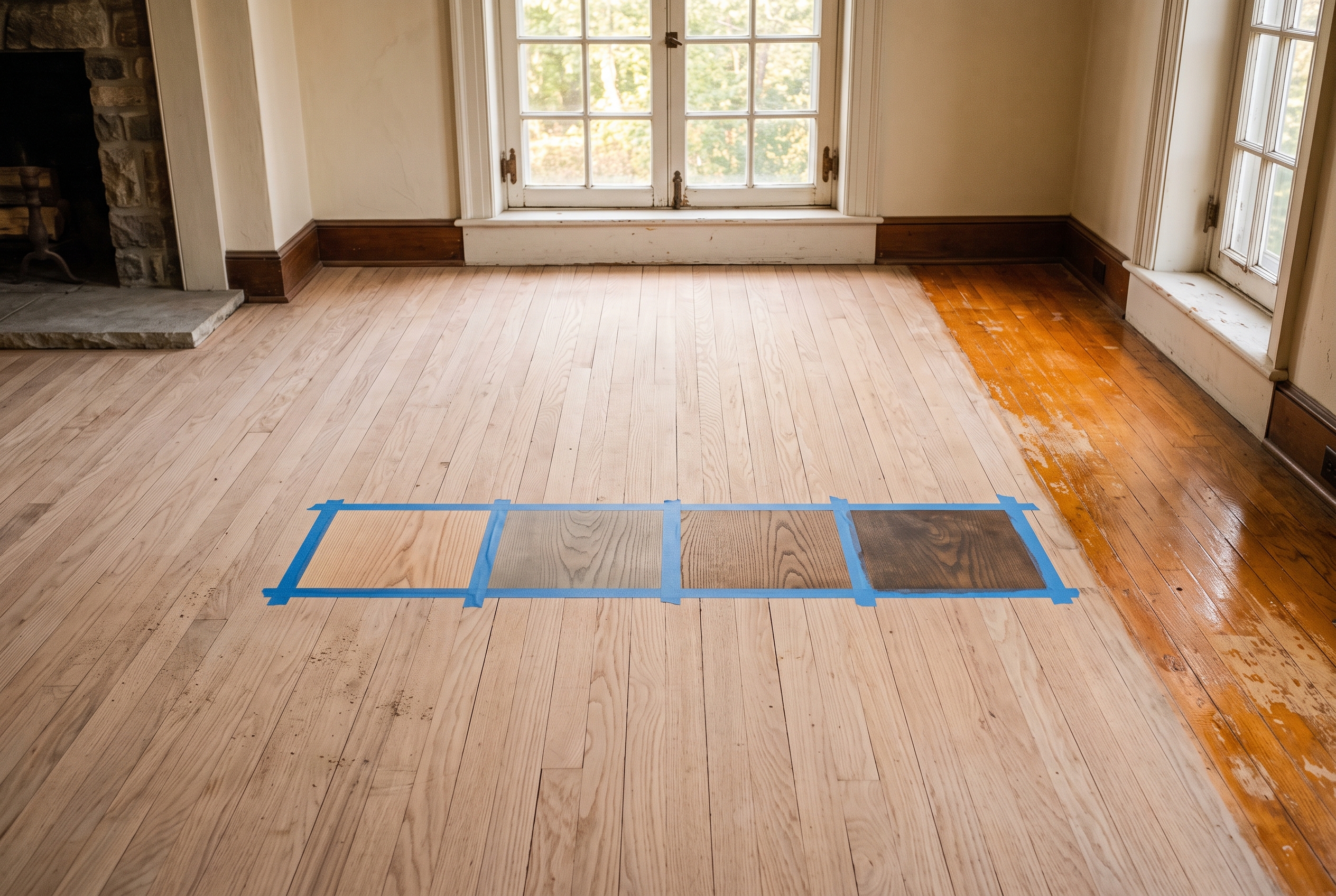
Yes. Sanding and staining a hardwood floor can take it darker, give it a different brown or bring it back to natural. With bleach, it can even go lighter than the wood itself. Stain adds color but can't take it away, so without bleach the bare boards set the lightest you can go.
Darker, or a different brown: the easiest change on any solid floor with enough wood left to sand. The darkest colors ask for the most careful sanding and the longest drying time.
Natural, whitewashed or less orange: sanding takes off the old amber finish that makes most dated oak look orange. A clear water-based finish brings back the wood's own color, and a white-tinted sealer under it gives a paler, whitewashed look.
Lighter than the bare wood: only a two-part wood bleach does this. Red oak comes out pinkish and white oak can turn faintly green, and each round softens the surface a little.
Gray: possible on both oaks, but red oak's pink undertone shows through a pale gray, so a sample on your own floor decides it.
Prefinished or engineered: the color can change only if enough real wood sits on top to sand through the factory finish, and beveled edges add work.
Most color goals need only a full sanding and the right stain or finish. Going lighter than the wood and changing a prefinished floor are the two that need more.
| Your goal | What it takes | What limits it |
|---|---|---|
| Darker or a new brown | Full sanding, samples, stain | Maple and pine can blotch |
| Natural or less orange | Full sanding, clear water-based finish | No lighter than the bare wood |
| Whitewashed or pale | White-tinted sealer or white stain | Red oak's pink still shows |
| Lighter than bare wood | Two-part bleach, then neutralizing | Pink or green cast, softer surface |
| Gray | Samples of several grays | Pale grays turn warm on red oak |
| Prefinished or engineered | Wear layer measured, then sanding | Thin wear layer, beveled edges |
What Sanding Removes, and What Comes Back
A full sanding takes off the old finish, the old stain and a thin skin of the wood, which is why every real color change starts there. If your floor looks orange or yellow, most of that color is in the old finish. Oil-based polyurethane goes on amber and keeps yellowing with age and sunlight, so a floor finished that way years ago has been getting warmer ever since.
Once the sander cuts through that finish, the bare boards look noticeably less orange than the floor you've been living with. Wipe a damp cloth across a sanded board for a fair preview of a clear finish. Wet wood shows the richer, deeper color that a finish brings out. It tells you whether natural is enough before anyone opens a can of stain.
What comes back is the wood's own aging. Wood keeps changing color under light for months and years, finished or not, and that change happens in the wood itself. A freshly sanded floor will slowly darken and warm again, even under a finish that stays clear.
If your floor is original oak in an older Main Line house, sanding also reveals its history. Replaced boards, old patches, sun-faded strips and lines where a wall or radiator once stood all show up. Our post on refinishing original oak floors in Main Line colonials covers what else a floor that age can bring.
Sanding and Staining Hardwood Floors, Step by Step
Refinishing and restaining a floor follows one order: repair, sand to bare wood, test colors, stain, let it dry completely, then seal and finish. Every step affects the final color, so none of them can be rushed.
- Damaged boards are replaced first, so the new wood is sanded and stained with the old.
- The whole floor is sanded to bare wood. Our hardwood refinishing crews use 99% dust-free sanding, with high-velocity vacuums on the machines.
- Stain samples go down on the sanded floor, and you choose once they're dry.
- For a deeper, more even color, the floor is water popped and left to dry overnight.
- The stain is applied, wiped off and left until it's completely dry.
- Sealer and finish coats go on. With our low-VOC water-based polyurethane, you can walk on the floor the same day the finish goes down.
Why the Sample on Your Floor Beats the Color Chip
The same can of stain looks different on your floor than on a chip, because your species and the way your floor was sanded decide the color. A swatch shows the color on the maker's sample wood, which may be a different species from yours.
Look at the samples once they're dry, in morning light and again at night, next to your cabinets and trim. Our post on choosing a hardwood color for your home's lighting explains why one color reads so differently in a sunny room and a dim one. To narrow it to two or three colors first, stop by the stain and finish displays in our Newtown Square showroom. You can also look through finished floors in our project gallery.
Water Popping for Darker, More Even Color
Water popping means dampening the bare floor evenly after sanding so the grain opens and takes more stain. It makes the color darker and more even, with less contrast between the hard and soft parts of the grain.
If you like the stain as it looks on a plain sample, or you want the grain to show, the floor is stained without it. Water popping adds an overnight dry, and any scuff on the damp, raised grain shows later as a light mark. On a thin engineered floor, or one that has been sanded many times, the water can cup the board edges, so it's usually left out there.
How Much Time and Money a Color Change Adds
A color change adds drying time and steps to a refinish. Stain needs anywhere from a few hours to overnight before the first coat of finish, and the darkest colors take longest. Water popping adds its own overnight dry, and bleaching adds at least a day for each round. Humid summer days here slow all of it, so we set the schedule around the color you choose.
The new color also has to run through every connected room to a natural stopping point, such as a doorway or a threshold. That often sets the square footage. For price ranges and what moves them, see our hardwood floor refinishing cost guide. We price your own floor at the free estimate.
How Your Wood Species Changes the Result
If your floor is oak, almost any color is within reach. Maple, pine and hickory can look blotchy under the same stain. Your species decides how evenly a new color takes, as well as how far it can go.
Oak is the most predictable species for a color change, and the others need more care.
| Species | How it takes stain | What to watch |
|---|---|---|
| Red oak | Readily, with a warm pink undertone | Light and gray stains show the pink |
| White oak | Readily, with a yellow to gray undertone | Bleach can leave a green cast |
| Maple | Unevenly; dense grain resists pigment | Blotching; best natural or lightly toned |
| Pine and hickory | Unevenly in places | Blotching; water popping helps |
| Two species or new boards | Each board its own way | Darker colors hide the difference |
If you're not sure which species you have, our hardwood flooring guide covers the basics, and we'll confirm it when we see the floor.
Red Oak and Gray Stains
Red oak takes stain well, but its pink undertone never fully leaves, and it warms toward red under a clear finish. In Mullican's comparison of its red and white oak, lighter stains make red oak's red undertone and white oak's yellow one easy to see, while darker stains narrow the gap. That's why a gray that looks cool on a sample card can come out warmer, even pinkish, on red oak. A darker gray hides more of the pink than a pale one.
White Oak
White oak is light brown, and some boards carry a pinkish tint or a slight gray cast. With less red to work against, it's the easier oak for natural, gray and pale Scandinavian looks, and it takes stain evenly. Its one surprise is the faint green that bleach can leave.
Maple, Pine and Hickory
Maple is the hardest common floor to restain. Its grain is dense, with very small pores, so pigment stain soaks in unevenly and can look patchy. Water popping deepens the color on maple but can still leave blotchy patches, and dyes spread more evenly but can fade over time.
That's why maple looks its best natural or lightly toned, and the darker the stain, the harder an even color gets. Old pine and hickory floors can blotch too, and water popping helps even them out.
Floors With Two Species or New Boards Mixed In
Older houses often have red and white oak side by side, or newer boards laced in where a wall or radiator came out. Each takes stain its own way, so a light color shows the differences and a medium or darker one hides them. If you want the floor to read as one, tell us before the samples go down.
Staining Hardwood Floors Darker
Any sanded solid hardwood floor can go darker, from a warm medium brown to nearly black. The darker the color, the more it depends on careful sanding, because dark stain shows sanding marks that a natural finish would hide. The darkest colors also take the longest to dry.
A very dark floor shows dust, pet hair and scratches more than a lighter one. If you want a richer color but share the house with dogs or a busy kitchen, a medium brown hides the most from day to day.
Refinishing Hardwood Floors Lighter
Most oak floors can be refinished lighter than they look today, as far as the color of their bare wood. The species, the finish and any old stain decide how close you get, and bleach is the only way past that point.
Getting Rid of Orange or Yellow Tones
An orange floor usually needs nothing more than a full sanding and a water-based finish, since the orange sits mostly in the old oil-based coats. Red oak is the one to set expectations for. Natural red oak will always read warmer than natural white oak. Your realistic choices are to stay light and accept some warmth, with a clear finish or a white-tinted sealer, or to move to a medium brown that hides the pink.
From a Dark Stain Back to Natural
A floor stained dark years ago can usually be taken back to natural oak. It takes a heavier first pass with the sander, which adds sanding time. Old stain packs into the soft grain and the cracks between boards, so it has to be cut out rather than sanded over.
If traces remain in the grain after a thorough sanding, a medium stain hides them better than a natural finish can. We'll show you both on your own boards before you decide.
Whitewashed and Scandinavian Looks
A pale, whitewashed floor often doesn't need bleach. The sealer coat under the finish sets the floor's overall tone, and waterborne sealers now come tinted. They run from a white-pigmented one for a whitewashed look to an amber one that gives the warmth of an oil finish without yellowing later.
White oak takes a white-tinted sealer or a white stain well. On red oak it softens the color, but the pink still shows through, so sample it first. Any white, pastel or bleached floor needs a non-yellowing finish, because an oil-based finish yellows with age and a white floor shows it first.
Bleaching Hardwood Floors to Go Lighter Than the Wood
Bleaching is the only way to take a floor lighter than its own bare wood, and only one kind of wood bleach can do it. Even then, the National Wood Flooring Association is clear that a two-part wood bleach changes the color without making the floor white. Red oak comes out with a pink cast, and white oak can turn slightly green.
Each of the three kinds of wood bleach removes something different.
- Two-part wood bleach, sodium hydroxide followed by hydrogen peroxide, removes some of the wood's natural color.
- Chlorine bleach, like the laundry kind, removes dye from wood but leaves its natural color alone.
- Oxalic acid is the one used on dark water and rust marks, and sometimes on pet stains.
Two-part bleach softens the wood's surface by pulling out the tannins that hold its fibers together, and every extra round leaves the floor a little more prone to dents. Each round dries overnight, and the floor is neutralized once the color is right. Most wood fillers can't be bleached, so filled gaps and nail holes may stay darker than the boards around them. The room also needs strong ventilation while the work is done.
Our team is trained in hardwood bleaching and specialty color work. At the estimate we'll tell you whether your floor is a good candidate, or whether a white-tinted sealer gets you close enough without bleach. A black pet or water stain that won't lift is usually a board to replace, and we do that as part of the same job.
Prefinished, Engineered and Textured Floors
If you bought your floor prefinished, the first question is how much real wood is left to sand. You can often see the wear layer's thickness at a floor vent or where a transition strip comes off, and we measure it before we quote. Our post on whether engineered hardwood can be refinished explains how thick it needs to be.
A factory finish with aluminum oxide in it takes more sanding to cut through than a finish applied on site. Sanding also reshapes beveled edges and can erase a shallow bevel entirely. Stain that settles into a bevel has to be wiped out, or it dries as a dark line. Some click-together engineered boards are built to be recoated rather than sanded, so if you still have the box or know the maker, its guidance comes first.
Hand-scraped and wire-brushed floors are their own case. Sanding them flat erases the texture, so a color change there means re-texturing the surface or accepting a smooth one.
Can You Change the Color Without Sanding?
No, not in a way you'd call a new color. A real color change needs a full sanding to bare wood. A light abrade and recoat freshens the finish and can change the sheen, but the color stays where it is.
Tinted topcoats exist, but dye mixed into a finish is very hard to apply evenly, and it only adds color on top of what's there. If your floor is dull and worn but you like the color, our Alpine Deep Clean may be all it needs. It scrubs the floor, buffs it without dust and adds two coats of water-based polyurethane in a day or two, for far less than sanding.
Choosing a Finish That Holds the Color
The finish is part of the color you see, so choosing it is a color decision too. The water-based polyurethane we use goes on clear or nearly so, and it doesn't keep ambering the way old oil-based coats did. That keeps a natural, gray or white floor close to the sample you approved. It also carries our two-year Alpine Guarantee.
If you'd rather have a matte, oiled look, our team is trained in Rubio Monocoat, WOCA and Bona Craft Oil finishes. Color oils like Rubio Monocoat's tint and protect the wood in a single coat, in dozens of shades.
Sheen changes how much light bounces off the floor, and with it how dark or light the floor reads across a room. Our post on hardwood floor sheen levels walks through matte, satin and gloss.
Changing Your Floor's Color in Newtown Square and on the Main Line
At Alpine Flooring & Design, we're Pennsylvania's largest hardwood floor refinishing company, working from our showroom at 5121 West Chester Pike in Newtown Square. We refinish floors across Newtown Square, Wayne, West Chester, Gladwyne, Havertown, Broomall, Media, Chester Springs, Paoli and Centreville, DE. We're also a member of the National Wood Flooring Association and a Certified Bona Craftsman.
If the smaller project is the right one, we'll say so. A floor that's only dull may need a deep clean, and a color you're unsure about can wait until you've seen it on your own boards.
Hardwood Floor Color Change Questions
How Many Times Can You Change the Color of a Hardwood Floor?
As many times as the floor can be fully sanded, since every color change starts with a full sanding. That depends on how much wood is left over the tongue, how flat the floor is and how skilled the sanding is. A thin engineered floor may have one sanding left, or none.
Will My Floor's New Color Change Over Time?
Yes, slowly, because wood keeps reacting to light even under a clear finish. A rug left in one spot leaves a paler patch that mostly catches up once it's uncovered, but never disappears completely. Moving rugs and furniture now and then in the first few months keeps the color even.
What Floor Color Is Best for Resale?
A medium brown is the safest color for resale. It suits the widest range of furniture and styles, and it hides everyday dirt and small scratches better than a very dark or very light floor.
Can a Stained Floor Be Recoated Later Without Sanding?
Yes, as long as the finish hasn't worn through to the stain. A maintenance coat lightly abrades the old finish and adds a fresh one, gently enough not to cut into the stain color. The routine in our hardwood floor care guide stretches the time before you need one.
Should an Old Floor Finish Be Tested for Lead Before Sanding?
Yes, if it may have gone down before 1978. Floor finishes from before then may contain lead. A color change always means sanding the old finish off, so a test beforehand tells you what you're dealing with.
Getting Your New Floor Color Right
Your new color depends on your species, your finish and how much wood is left, and all three are easy to check in person. We'll measure the floor, look at the wood, check its sanding history and talk through the colors that will work on it. Book your free refinishing estimate and we'll help you choose a color you'll enjoy for years.


