

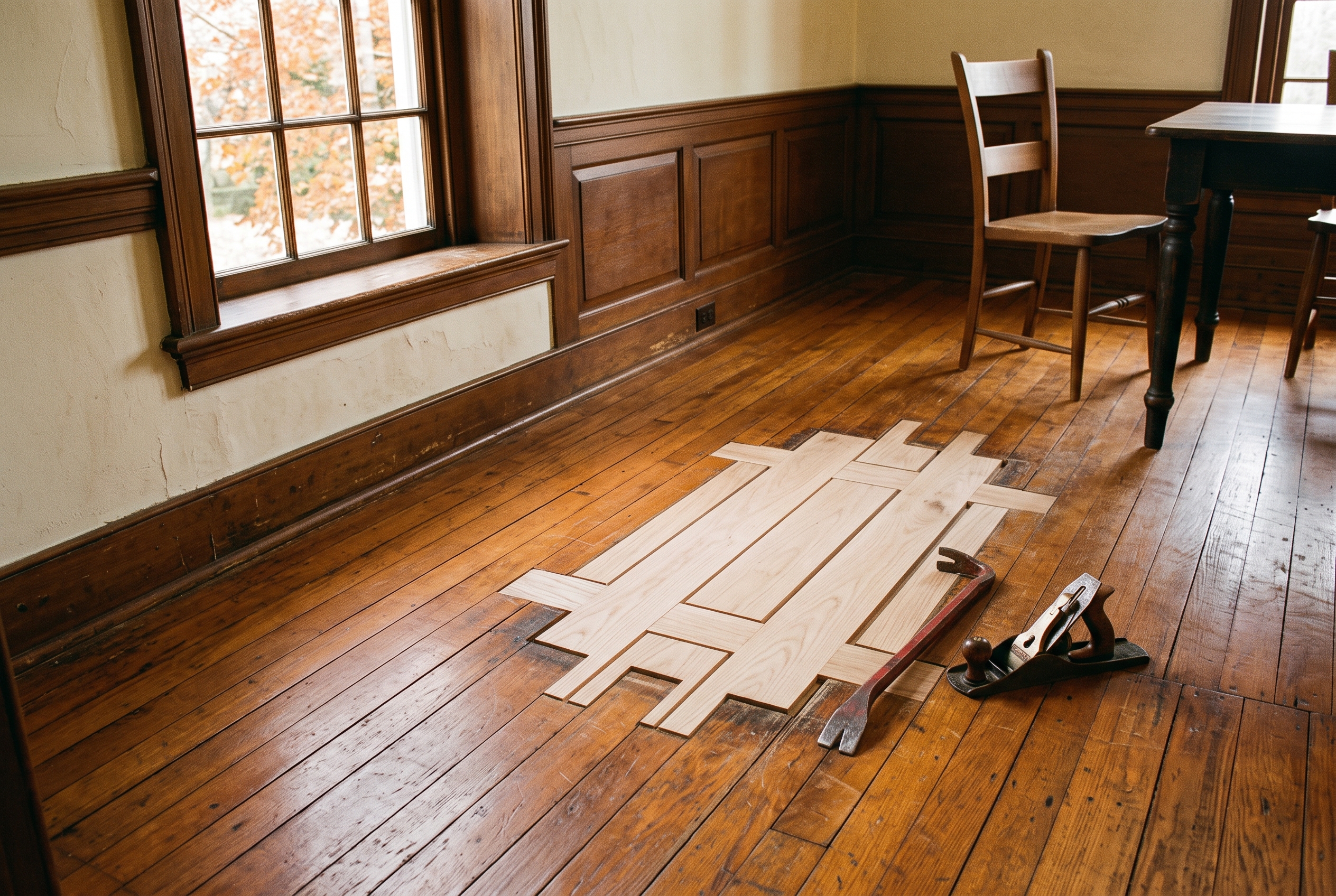
Yes, a damaged hardwood board can be cut out and replaced on its own, and the boards around it stay where they are. Whether you also avoid refinishing the room depends on the finish, not the carpentry. The new board has to blend into wood that has been changing color for years, and your kind of floor sets how far the sanding or recoating has to reach.
Prefinished floor (finished at the factory): usually no refinishing at all. The damaged plank comes out, a new one is glued in, and its beveled edges, the slight V where planks meet, are touched up. You need a leftover plank from your installation or one that matches it closely.
Site-finished floor with a clear finish in good shape: often a local blend and a fresh coat across the room, with no full sanding. That works when the new boards match your wood and the floor was never stained.
Stained floor, or oak under an old amber finish: plan on sanding at least to the nearest doorway, and often the whole connected floor. New wood won't take the stain the way your aged boards did.
Water or pet damage: the damaged boards come out, after a leak only once the floor has dried, and the subfloor gets checked before new wood goes down.
Here is the finish work each kind of floor usually needs once the damaged boards are out.
| Your floor | Finish work to expect | What decides it |
|---|---|---|
| Prefinished (factory finish) | None beyond a bevel touch-up | A leftover or matching plank |
| Site-finished, clear finish | Blend the patch, recoat the room | Boards that match your wood |
| Stained, or old amber finish | Sand to a doorway or the whole floor | How new wood takes the color |
| Water or pet damaged | As for its floor type, once dry | The subfloor underneath |
Which Damage Needs a New Board and Which Can Be Fixed in Place
Not every mark on a hardwood floor needs a new board. We fill and blend scratches, small dents and shallow gouges where they are. A board comes out when the damage runs deep into the wood, when the wood itself has turned dark, or when the board has buckled, split or gone soft.
Most damage falls into one of these patterns, and only some of them call for a new board.
| Damage | Usual fix | New board needed? |
|---|---|---|
| Fine scratches in the finish | Recoat | No |
| Deep scratch, dent or small gouge | Color-matched filler, then finish | Rarely |
| Long gouge, split or missing chunk | Replace the board | Usually |
| Gray stain from pets or water | Sands out if caught early | Usually not |
| Black or soft stain | Replace boards, check the subfloor | Yes |
| Slight cupping after a leak | Dry the floor, then decide | Often not |
| Buckled boards | Replace where it lifted | Yes |
| Strip where a wall stood | Lace in new boards | Yes |
| Old radiator pipe holes | Fitted wood patch or new boards | Sometimes |
Scratches, Gouges and Dents
Scratches you can't catch with a fingernail sit in the finish only, and a fresh coat hides them. Deeper scratches, dents and small gouges tear or crush the wood itself. On a single board, we can usually fill them with a color-matched filler, grain the fill to look like the wood around it and seal it at the same sheen.
The board comes out when a gouge is long, wide or deep enough that filler would read as a patch, or when the wood has split or a piece has broken away. Scratches spread across a whole room mean the finish is worn, and the signs your hardwood floors need refinishing tell you whether the whole floor is due.
Pet Urine Stains
Pet urine stains sort themselves by color. A light gray or tan stain near the surface usually comes out when the floor is sanded. A stain that has turned the wood dark brown or black has reacted deep into the board, deeper than a sanding can reach. Dark pet stains mean new boards, and we cut those out and weave in replacements.
Soft wood, or a smell that comes back after cleaning, means the urine has usually reached the subfloor too. That section of subfloor is repaired before new boards go down, or the odor stays. Pet stains also tend to gather in one spot, by a back door or a favorite corner, so the repair is usually a group of boards woven in at staggered lengths.
Water-Damaged, Cupped or Buckled Boards
After a leak, fix the source and let the floor dry before anyone pulls a board or sands anything. Cupped boards, with edges higher than their centers, often flatten as they dry. The National Wood Flooring Association notes that minor water damage can fade or disappear completely as a floor dries out, so running the air conditioning or a dehumidifier and waiting is often the first repair.
Sanding a cupped floor flat while it's still wet is the classic mistake. When the wood dries, the sanded-off edges end up lower than the middles, and the floor crowns.
Buckled boards are a different case. Once a board has lifted off the subfloor, its nails or glue have let go, and it has to be replaced. Water stains follow the same line as pet stains: a gray mark beside an old radiator usually sands out if it's caught early, and a black one means a new board.
The subfloor under a leak can be in worse shape than the boards on top. Call us once the leak is fixed. At a free in-home estimate we check the boards and the subfloor, tell you what can stay, and repair the subfloor where it has swelled or softened.
Why a New Board Stands Out Even in the Same Wood
A new board stands out because your floor has changed since it went in. The replacement can be the right wood in every way and still look new, because your old boards have had years of light, finish and foot traffic that it hasn't. Each of those shows up next to a patch.
Light changes the wood under the finish. Depending on the species, wood warms, turns more yellow or darkens, and exotic species usually grow darker. It's the same reason the floor under a long-standing rug is a different color from the floor around it.
An oil-based finish adds its own color. Oil-based polyurethane goes on amber, and on an older floor it sits over wood that has been warming for decades. Water-based finishes go on clear, so a new board under a fresh water-based coat can look pale and cool beside that, even when the wood is a perfect match.
New wood also takes stain its own way. A fresh board and a well-aged one of the same species take the same stain differently. Red oak, with its reddish tone, and white oak, which runs light brown, look alike to most eyes but stain apart. A patch in a stained floor is matched by testing samples on the new boards themselves, never by the name on an old can.
Traffic has dulled the old finish as well, so a fresh coat on the patch alone shines when low sun crosses the floor. The match is made in the finishing, which is why your floor's finish decides how much of the room gets involved.
Replacing Boards in a Prefinished Floor Without Sanding
A prefinished hardwood floor, one that came from the factory already stained and finished, is the easiest floor to patch. A damaged plank is cut out and a new one glued in, with no sanding and no new finish on the rest of the room. Some plank-to-plank color variation is part of how a prefinished floor looks, so one well-chosen replacement reads as part of the pattern.
The best replacement is a plank left over from your installation. It came from the same production run as your floor, so if you kept a carton in the basement or garage, it's the first thing we'll ask about. A plank that spent those years in a carton has missed the light your floor has had, so it will look a little fresher at first and close some of that gap over time.
A new carton of the same product can be a shade further off. Color varies from one production batch to the next, and makers change their finishes over the years. The replacement doesn't have to come from your floor's maker, though. Any board with the same profile, width, bevel, edge, cut and grade will fit, which helps when a product has been discontinued.
With no leftover plank, borrow one from inside a closet or under furniture that never moves. Use it for the visible repair, and put the new plank where nobody will look. The damaged plank is cut out down the middle and lifted out in pieces without touching its neighbors. The new one is trimmed to drop into place, glued, weighted flush and touched up on its beveled ends.
How Far the Refinishing Has to Reach on a Site-Finished Floor
A site-finished floor, one sanded and finished in place after it was installed, takes new boards just as easily, but the new wood arrives raw and has to be finished to match. Depending on your finish, that finishing runs from a small area plus a room-wide coat to sanding the whole connected floor.
A Clear Finish Still in Good Shape
If your floor has a natural, unstained finish that's still intact, the patch can often be sanded and finished on its own. Then the whole room gets a fresh coat so the sheen matches wall to wall. The room-wide coat is what makes the repair disappear, because a coat on the patch alone leaves it glossier than everything around it.
That coat is the same one our Alpine Deep Clean puts down, after a machine scrub and a dust-free buff: two coats of water-based polyurethane, usually done in a day or two. A new coat only bonds to a clean finish, though. Floors treated with polishes, "restorers" or wax often can't take a recoat without stripping or a full sanding, so tell us what has been used on yours.
Some refinishers sand every patched room as a rule. We'd rather look at your floor first. With matching wood under a clear finish in good condition, a local blend and a room recoat is often invisible, and when it wouldn't be, we'll tell you before any work starts.
A Stained Floor or an Old Oil Finish
On a stained or amber-finished floor, the patch can't be colored one board at a time, because fresh wood and aged wood take the same stain differently. The fix is to sand an area big enough to hide the edges down to bare wood. Stain samples are tested on your sanded boards and the new ones side by side, and the whole area is colored and finished at once.
The sanded area can end at a doorway, a threshold or a change in board direction, where the eye expects a break. It should never end in the middle of an open floor, where the line between old and new finish shows across the room. If you've been wanting a different color anyway, the repair is a natural moment to change it.
Open Floor Plans With No Doorway to Stop At
In an open plan, or a hall that runs unbroken into three rooms, there's no natural place to stop. The sanding runs the length of the continuous floor, and a patch repair becomes refinishing more than the room.
When that's the answer, our hardwood refinishing crews sand with high-velocity vacuums that capture 99% of the dust. The water-based polyurethane we use can be walked on the same day, and we move the furniture for you.
Patching Where a Wall, Radiator or Floor Vent Used to Be
A patch where a wall, radiator or floor register used to be can disappear completely when the boards on both sides run the same way. Older houses around the Main Line and Delaware County are full of them. A wall comes down between the kitchen and dining room, radiators give way to forced air, a register moves, and each leaves a strip or a row of holes in otherwise good oak.
Where a wall stood, the boards on both sides are cut back at staggered lengths and new boards are laced into the gaps. Done right, no straight seam or H-shaped joint gives the patch away. It works cleanly when both rooms have the same species and board width and the boards run the same direction.
Once the wall is gone, the two rooms are one floor. The laced strip gets sanded and finished together with both of them, out to the doorways of the new open space, and the old wall line disappears inside it.
When one room's boards run the other way, or the two rooms were floored in different wood, weaving can't hide the change. A deliberate border or header board, a single board or band laid along the old wall line, usually looks better because it looks planned. Our team is trained in custom borders and inlays, and in working with reclaimed hardwood.
Holes from old radiator pipes can be filled with a wood patch cut to fit and matched to the grain. That works well near a wall or under furniture. Out in the open, replacing the drilled boards with full-length ones looks cleaner than a plug, and an old register opening is woven in the same way as a wall line.
The best match for old wood is old wood: boards borrowed from inside a closet and replaced there with new ones, or reclaimed boards from the same era. New boards are the fallback, and they sometimes need their backs planed or shimmed, because older floors don't always match today's thickness. Many old floors were also fastened with cut nails that a saw blade won't cut through, one more reason repairs in original oak in Main Line colonials take care.
How a Damaged Hardwood Board Is Replaced
A damaged hardwood board is replaced by cutting out its middle, lifting out the pieces and dropping in a new board trimmed to fit over its neighbors. None of the boards around it has to come up. The carpentry is quick, and the care goes into choosing the board and getting it ready.
- The replacement is chosen first. It has to match the old board's species, grade, cut, width, thickness and edge profile, and it's in hand before the old board is touched.
- The new board acclimates until its moisture content is within 2 points of your floor's. A board that is wetter or drier than its neighbors will shrink or swell once it's in, opening a gap or pushing against them.
- The old board is cut out. A saw set to the board's depth makes two cuts along its length and angled cuts across the middle. The center lifts out, and the edges come free with their nails.
- The new board is fitted. The lower lip of its groove and its end tongue are trimmed so it drops in from the top. It's glued, pressed flush, and planed on the back if its thickness differs.
- The finish is matched. Nail holes and joints are filled, and the new wood is finished to blend with the floor around it.
In our humid summers, only one board at a time should be opened up, so the floor can't swell into the gap before the new board is in.
Can You Replace a Hardwood Floor Board Yourself?
Yes, if the floor is prefinished and you have a leftover plank. Cutting out a board takes a circular saw, a chisel and care not to nick the boards beside it. On a site-finished floor, it's the finish match that makes most do-it-yourself patches show.
Before you cut, find out what's under the floor. Radiant heat tubing, a glued-down installation or a floating floor each change how a board comes out, and the saw has to be set to the board's thickness so it doesn't cut into what's underneath. If your house was built before 1978, have the old finish tested for lead before you sand it. The National Wood Flooring Association's guidelines point out that some floor finishes made before then contained lead.
What a Patch Repair Costs Compared With Refinishing the Room
A patch repair is priced by the work around the boards more than by the boards themselves. Swapping two planks in a prefinished floor is a small job. Weaving eight boards into a stained oak floor and blending the finish to a doorway is a much bigger one, even when the damage covers the same area.
The price moves with how many boards need replacing and whether they're together, whether matching wood is on hand, how far the finish has to blend and whether the subfloor needs repair. We price repairs at a free in-home estimate, once we've seen the floor, the finish and the damage.
If the blend has to run through the whole floor, the per-square-foot ranges in our guide to hardwood refinishing costs on the Main Line apply. And if the rest of the floor is worn anyway, doing the repair as part of a full refinish means paying for the blending only once.
Hardwood Floor Repair in Newtown Square and on the Main Line
At Alpine Flooring & Design, we repair hardwood floors from our Newtown Square showroom across the Main Line and Delaware and Chester counties, including Wayne, West Chester, Gladwyne, Havertown, Broomall, Media and Paoli. Flooring repairs and subfloor repair are part of our flooring services, next to refinishing. We're Pennsylvania's largest hardwood refinishing company, so the finish work that decides whether a patch disappears is what our crews do every day.
Whoever you hire, ask where the replacement boards will come from, whether they'll be acclimated before they go in, and how far the finish work will run. Clear answers to those questions are a good sign the patch will match.
Hardwood Patch Repair Questions
Will a New Hardwood Board Darken to Match the Rest of the Floor?
No, not completely. A new board changes color under light the way your old boards did, so the difference narrows over the first months and years, but the old floor keeps changing too. Mirage says the same about a floor uncovered after years under a rug: the paler area grows much less noticeable but never matches completely. A patch that's close on day one usually gets better, and one that's clearly off won't fix itself.
How Long Does a Hardwood Patch Repair Take?
It depends on the finish work more than the boards. Replacing a few boards is the short part of the job. Our room-wide deep clean and recoat is usually done in a day or two, and after a full sand and refinish with our water-based polyurethane you can walk on the floor the same day. Water damage adds however long the floor takes to dry.
Are Gaps Between Hardwood Boards Damage That Needs Patching?
No, not usually. Gaps that open in winter and close again by summer are normal seasonal movement, and they don't call for new boards. Heated winter air dries floors out here, and humid summers swell them, so keeping the house between 30 and 50 percent humidity year-round keeps that movement small. Gaps that are wide, or that stay open through the humid months, point to a moisture or installation problem worth having us look at.
Can a Loose or Squeaky Board Be Fixed Without Replacing It?
Yes, usually. A board that pops, flexes or sounds hollow underfoot can often be secured by drilling a small hole, injecting adhesive underneath and plugging the hole. A loose board can be fastened down again. We reset loose boards as part of our repair and refinishing work, and we save replacement for boards that are split or damaged.
Can Engineered Hardwood Be Patched and Sanded?
Yes to the patch, and the sanding depends on the wear layer. An engineered plank swaps out the same way a prefinished one does. Whether the area can then be sanded to blend depends on the thickness of its real-wood top layer, which we measure before we quote. Our post on whether engineered hardwood can be refinished explains the thicknesses.
Can a Damaged Laminate or Vinyl Plank Be Replaced the Same Way?
Yes, and there's no finish to blend. On a click-together laminate floor, the rows are usually taken apart from the nearest wall back to the damaged plank, or a single plank is cut out and replaced. Glue-down luxury vinyl planks can be lifted and replaced one at a time. Either way, the match depends on planks from the same run, so keep a carton, wrapped and labeled, after any new floor goes in.
Getting Your Damaged Boards Looked At
The quickest way to know whether your repair can stay a patch is to let us see it. Book a free in-home estimate, and we'll check the damaged boards, the finish and what's underneath, then tell you how far the repair needs to reach.


